
Infrastructure Report
For the managers overseeing expansive properties—sprawling commercial campuses, industrial manufacturing plants, and wastewater facilities—the most critical infrastructure is completely invisible. Underground pipelines dictate whether a facility operates smoothly or grinds to a halt. Yet, when a drainage issue arises, most decision-makers are forced to rely on outdated, limited tools that leave them practically blind to what is happening beneath their concrete.
The industry standard for diagnosing an underground pipe is a flexible push-camera. For a typical residential property, this works. But for large-scale facilities, it presents a massive operational hazard. These standard cameras must be manually shoved down a line, meaning they realistically max out around 150 feet of coverage.
Worse, as they are forced through larger commercial pipes (anything over six inches in diameter), the flexible cable inevitably twists, bends, and coils inside the line. When this coiling happens, the distance tracker on the technician’s screen becomes entirely inaccurate. The screen might read that a blockage is 60 feet away, when in reality, the camera is tangled up at 40 feet.
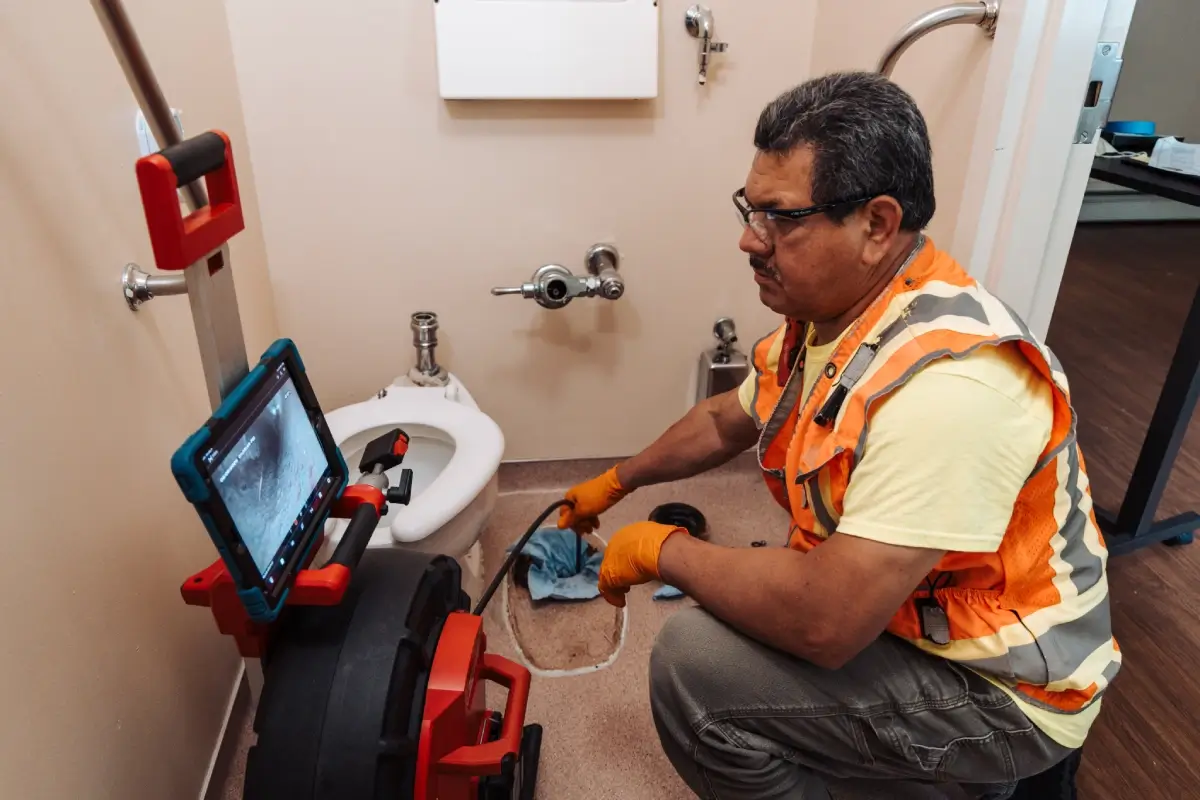
The Problem with Digging Blind
This physical limitation leaves facility directors with an unacceptable choice: authorize destructive, highly expensive excavation projects based on an inaccurate guess, or ignore the blind spots and wait for a catastrophic pipe failure.
Large-scale infrastructure challenges require a team with large-scale solutions. Recognizing the severe limitations of standard drain scopes, Lovett Services has deployed specialized Pipe Inspection Trucks designed specifically for heavy-duty commercial and municipal needs. Instead of manual push-rods, these units utilize motorized, heavy-duty wheeled crawler systems, giving facilities absolute clarity without the chaos.
How Mainline Crawlers Eliminate the Blind Spots
To truly evaluate the health of an expansive property, technicians must be able to go deeper, see clearer, and track their location with mathematical precision. Watch the breakdown below to see how our motorized inspection rigs navigate commercial infrastructure.
Uninterrupted 1,500-Foot Penetration
Instead of a flexible rod that coils and buckles, the inspection crawler is tethered by a heavy, rigid cable and driven by a motorized wheeled chassis. Controlled remotely by an on-site technician, it travels in a perfectly straight, powerful line. It easily pushes through standing water, heavy sludge, and debris, giving it a staggering range of up to 1,500 feet from a single access point.
Adapting to Any Environment on the Fly
Underground infrastructure is rarely uniform. The crawler system features interchangeable, modular wheel setups. Technicians can swap tires and adjust the height of the rig mid-job, ensuring the camera remains perfectly centered for optimal lighting and precise data, regardless of the pipe’s size or material.
Multi-Angle Vision & Safe Retrieval
The mainline crawler features a high-definition, 360-degree pan-and-tilt head, allowing the operator to look directly at structural joints with 90-degree precision. To solve the liability of reversing a heavy machine out of a 1,000-foot run, the unit is equipped with a rear-facing backup camera, ensuring safe retrieval past jagged roots or structural breaks.
The "Lateral Launch" Advantage
Inspecting branch pipes connecting buildings to the main line historically required entering the building or digging. The inspection truck eliminates this. As the main crawler moves down the exterior main line, it can deploy a secondary camera out of its chassis directly into the branching pipe. Facilities get a full inspection strictly from the outside, with zero interior disruption.
Surgical Mapping via Radio Location
The entire system is tracked by highly accurate digital distance counters and built-in radio beacons. If a critical failure or blockage is discovered deep underground, technicians can walk above ground and pinpoint the exact square foot and depth of the issue.
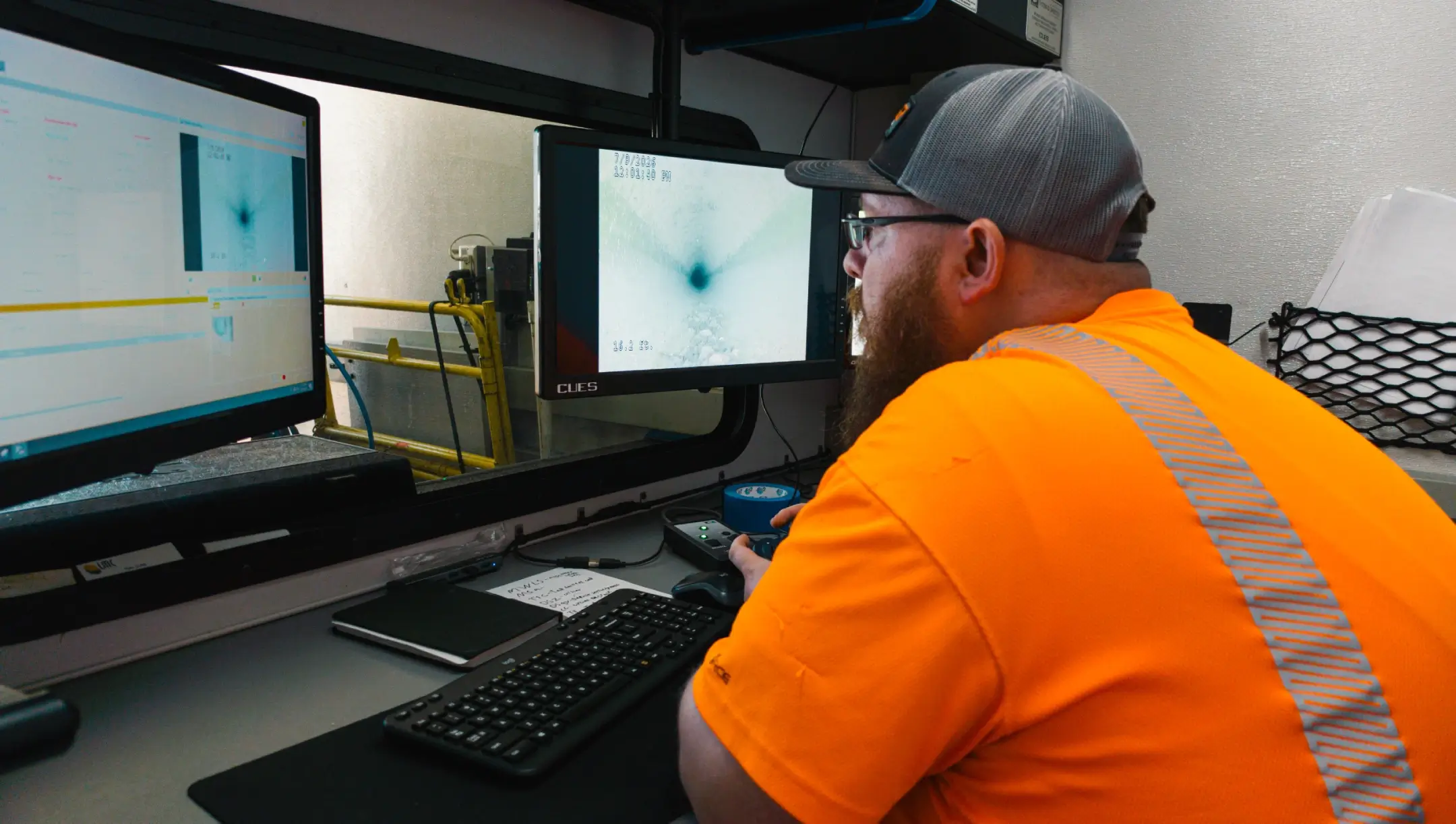
Risk Mitigation and Precision
The ultimate goal for any commercial property is keeping operations running smoothly while controlling capital expenditures. Relying on coiled push-cables results in inaccurate data, missed targets, and unnecessary excavation.
By utilizing a motorized mainline crawler, facility managers achieve complete infrastructure clarity from a single access point. If repairs are ever required, crews dig exactly where the problem is and nowhere else—saving thousands in surface restoration costs, generating undeniable high-definition video proof for upper management, and entirely preventing operational shutdowns.